

President Donald Trump’s order to freeze most federal grants and loans has created panic and uncertainty within the agriculture sector, which relies on billions of dollars in direct government assistance for loans, disaster relief and conservation practices.
On Monday, the White House issued a memo ordering a freeze on most federal grants and loans for review to align with Trump’s agenda. A federal judge blocked the order on Tuesday. The Trump administration later rescinded the memo but said it would continue to scrutinize federal funding.
Rob Larew, president of the National Farmers Union, said farmers and ranchers throughout the U.S. were confused by this week’s order.
Join us to fuel our investigative journalism.
<!-- PayPal Button Container -->
<div id="paypal-button-container"></div>
“We're getting questions from our members who have made investments on a number of fronts, everything from commercial kitchens to building out processing to even big questions about the IRA,” said Larew, referring to the Inflation Reduction Act. “We have very few answers right now and lots of questions.”
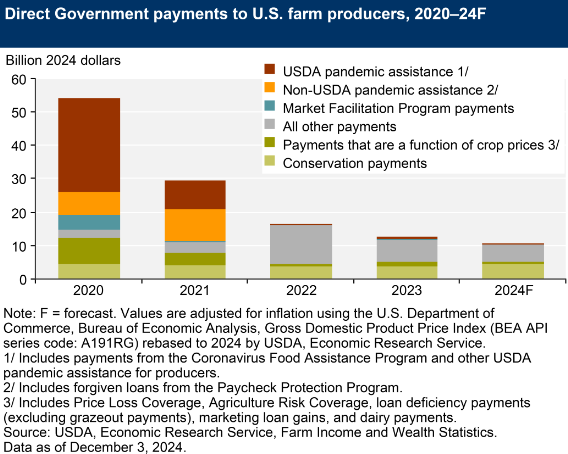
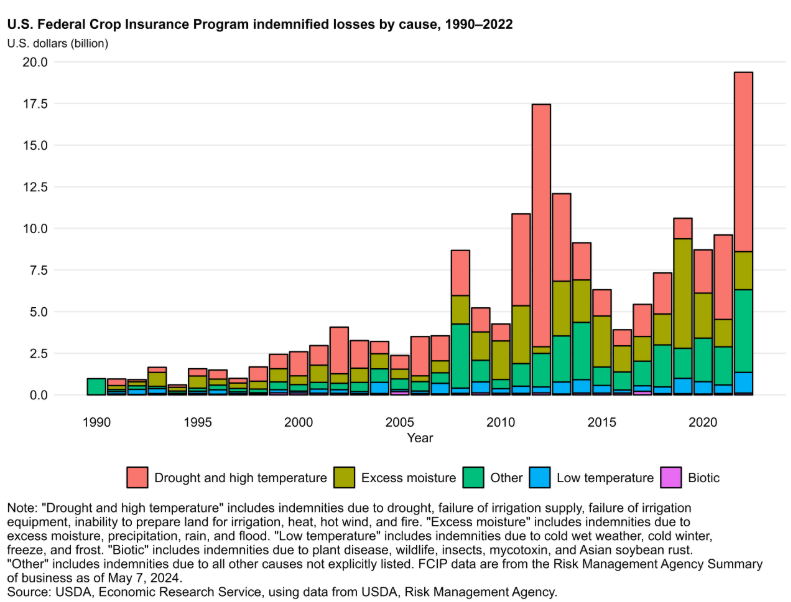
Farmers received more than $10.5 billion in direct government payments in 2024, nearly half of which came from conservation programs. That figure does not include Federal Crop Insurance, which accounted for over $19 billion in 2022.
After hearing about Trump’s order, Richard Lyons, a farmer and director of the Illinois Association of Drainage Districts, said he was worried about an already approved $2.3 million low-interest federal loan to replace drainage tiles in Montgomery County. The loan is part of a $307 million USDA grant to modernize rural drinking water and wastewater infrastructure.
Drainage tiles are pipes buried under farmland that carry away excess water. First built in the 1890s, many of the tiles in Montgomery County are collapsing, which causes flooding, Lyons said.
“My concerns are that Trump has no knowledge, zero knowledge of which is important relating to agriculture, especially agricultural drainage,” Lyons said.
Harvel Drainage District No. 2, which includes Montgomery County in west central Illinois, has already spent $140,000 for engineer assessments and attorney filing fees, Lyons said.
With the new system, the drainage district, which serves 20 different farming operations, will be able to monitor whether growers are in compliance with state phosphorus and nitrogen levels. Broken drainage tiles could also lead to a significant reduction in corn yield.
“If it comes to the point that we cannot get our loan, we're still going to go ahead and do the project and pay the extra money, because the system needs to, it has to, change,” Lyons said.
Some lawmakers worry about future IRA funds for farmers
Before attempting to freeze federal grants and loans, Trump signed an executive order suspending all Inflation Reduction Act funding disbursements, including the USDA’s Partnerships for Climate-Smart Commodities, a program aimed at supporting sustainable farming practices.
The IRA, a cornerstone of former President Joe Biden’s climate policy, allocated $400 billion in funding and tax credits to spur conservation and green energy efforts.
At the National Farmers Union’s annual meeting in Peoria on Thursday, Illinois U.S. House Rep. Eric Sorensen, D-Moline, defended IRA funding, saying it has been a positive for farmers and he wants to see them protected.
“We need to make sure that we do everything that we can to keep the benefits of the Inflation Reduction Act in the Farm Bill, especially when it comes to conservation, because the other side, they want to gut that. They want to take it out,” Sorensen said. “They don't know enough about farming and how important it is, also how important those decisions are for our kids and our grandkids.”
Sorensen, who sits on the House Committee on Agriculture, stated his commitment to passing a new Farm Bill that strengthens crop insurance, supports fair premiums for farmers, expands agricultural export programs, and funds voluntary conservation and smart farming practices.
Citing his experience as a meteorologist in Illinois and Texas, Sorensen underscored the importance of a robust crop insurance program in the face of extreme weather events and climate change.
“However, the devil is in the details, the new administration is going to give us more pressure to gut critical parts of this Farm Bill,” Sorensen said. “Cutting benefits for those who need help, that's not a way that we reduce waste in our government.”
Citations & References:
Interviews
Rob Larew, National Farmers Union president, Jan. 28, 2025
Rep. Eric Sorensen (D-Moline), Jan. 28, 2025
Richard Lyons, Illinois Association of Drainage Districts director, Jan 28-29, 2025
News reports
The Inflation Reduction Act: Here’s what’s in it, McKinsey & Company, Oct. 24, 2024
Data Direct Government payments to U.S. farm producers, 2020–24F, USDA ERS, Dec. 3, 2024
FCIP indemnities by cause of loss, USDA ERS, May 20, 2024
Federal government publications
Federal Crop Insurance: A Primer, Congressional Research Service, Feb. 18, 2021
Water and Waste Disposal Loan and Grant Program, USDA, July 7, 2021
Biden-Harris Administration Invests $307 Million in Rural Water and Wastewater Infrastructure Improvements in 34 States and Puerto Rico, USDA, July 7, 2021
USDA Inflation Reduction Act, archived Jan. 17, 2024
Trump administration documents
OMB memo on temporary pause of financial assistance programs, Jan. 27, 2025 Unleashing American Energy, Executive Order, White House, Jan. 20, 2025
