

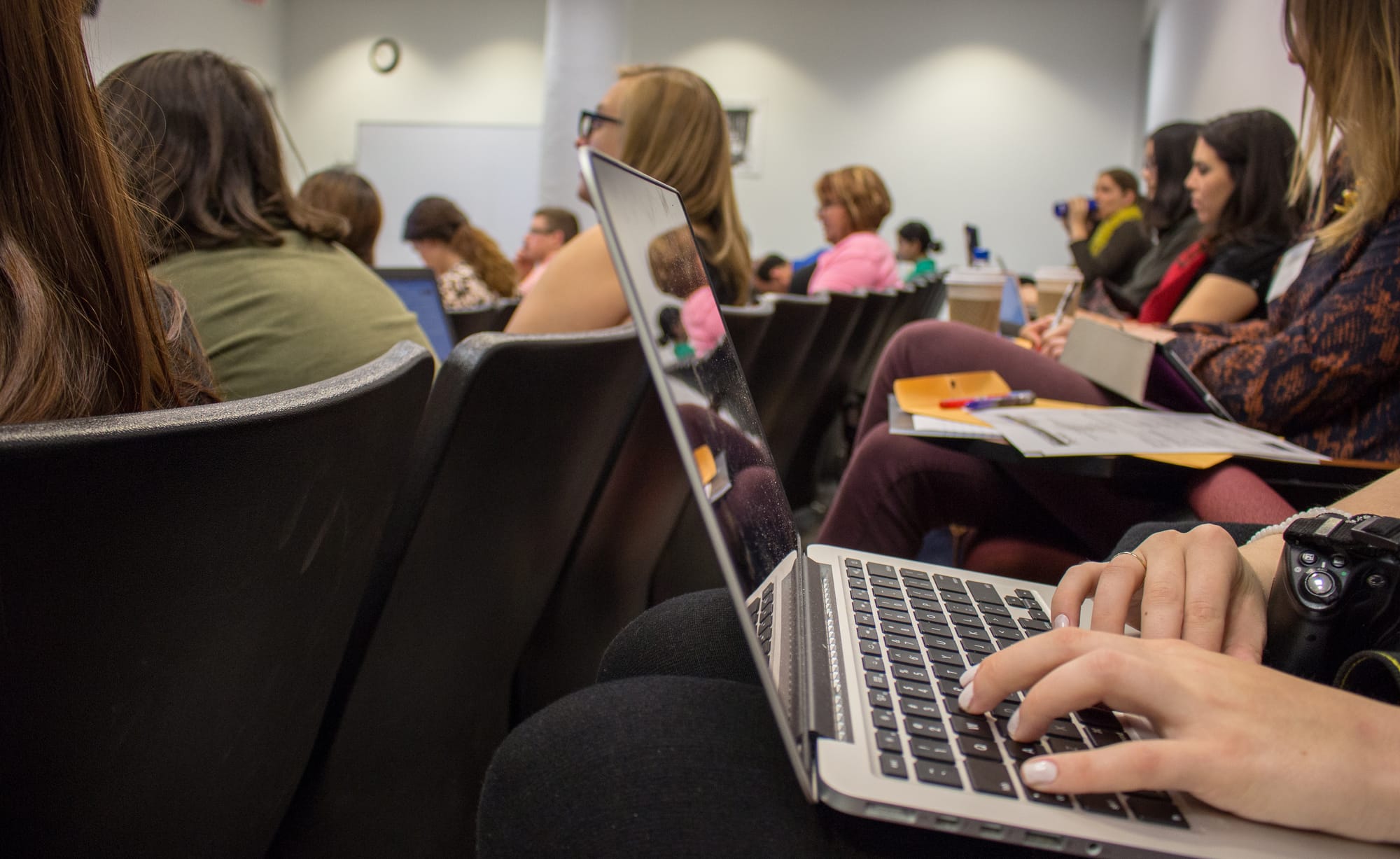
In 2015, the Midwest Center for Investigative Reporting hosted a workshop on how to cover the U.S. visa system.
The workshop, “Covering the U.S. Visa System in Your Own Backyard,” was part of a specialized reporting institute supported by the Robert R. McCormick Foundation and Poynter.
As many as four federal agencies – the U.S. Department of Labor, the Department of Homeland Security, the Department of State and the Department of Justice – are involved in regulating the visa process and there is no evidence that they all work together.
Below is a list of sources related to the U.S. visa system:
Visa directory
Overall, there are two overarching categories for visas: immigrant visas and nonimmigrant visas. Immigrant visas are for individuals looking to move and live in the United States, while nonimmigrant visas are only for temporary work, travel or study.
Within those two categories, there are dozens of different specific visa categories. For instance, there is the B-1 visa for athletes, the J-visa for au pairs, the B-1 visa for business visitors, the A-visa for diplomats, the J-visa for exchange program visitors and the I-visa for media members.
Visa glossary
There are dozens of different visa categories managed by multiple federal agencies. As a result, there is a seemingly infinite amount of specialized words reporters need to know to cover the system. This glossary provides definitions of those words, such as: “nonimmigrant,” “derivative,” “naturalization” and “overstay.”
State department annual reports
The U.S. Department of State releases visa report each year. The reports provide quantitative information on how many visas were issued across a four-year period. In 2016, the annual report shows that there were 617, 752 immigrant visas issued.
Securities and Exchange Commission reports
According to 2016 testimony by Stephen Cohen, associate director of the SEC’s Division of Enforcement: “The SEC’s tripartite mission is to protect investors, maintain fair, orderly, and efficient markets, and facilitate capital formation. The SEC’s Division of Enforcement furthers this mission by, among other things, investigating potential violations of the federal securities laws, recommending that the Commission bring cases against alleged fraudsters and other securities law wrongdoers, and litigating the SEC’s enforcement actions. Through its Office of Investor Education and Advocacy (OIEA), the SEC also protects investors by disseminating information to the investing public to educate investors and allow them to make informed investment decisions.”
Use this search tool to find reports and testimony regarding visas.
U.S. Immigration and Customs Enforcement reports
Immigration and customs maintains a valuable set of data and documents online.
This 2016 quarterly report on student and exchange visitors, for instance, includes everything reporters need to know for a basic overview on F, M and J-visas. According to the report, there are nearly more than 1.2 million F and M students in the United States, as well as about 198,200 J-1 exchange visitors.
There are also 8,697 certified schools that can accept international students.
Additional resources include:
- Visa fraud: Visa fraud can be perpetrated in several different ways from falsifying documents to sham universities exploiting the visa system thru making a profit off foreign students.
- EB5 program: People can invest $500,000 to $1 million to get a visa.
- The Diversity Visa Program: The program is a lottery to get into the United States that admits 50,000 people per year.
- Inspector General reports for the Department of Homeland Security, the United States Department of Labor (for work-related visas), and the State Department (especially for U-visas and T-visas)
- The Government Accountability Office and its news-alert feature
Human trafficking and the T-visa
A T-visa is designed for people who are coerced or enticed to enter the United States. Once these people are in the country, they are forced to do labor or sex work with no realistic means of escape. Law enforcement officials are encouraged to confirm a visa applicant’s cooperation in an investigation, but that confirmation is not necessary as part of the visa process. The government caps T-visas at 5,000 per year.
Domestic abuse, criminal activity and the U-visa
A U-visa targets people who qualify as victims of criminal activity and domestic violence. When covering U-visas, it is important for reporters to keep in mind thaw law enforcement officials hold a lot of power during this process. A victim needs confirmation from authorities that they have been helpful in a particular case.
Main work visas
- H-1B visa: This visa is for workers in specialty occupations who have a bachelor’s degree or higher. It lasts for three years and can be renewed afterward. It is relatively costly for the employer, who has to petition the federal government to secure a visa. The visa is capped at85,000 per year, and the first 20,000 spots are reserved for individuals with a master’s degree.
- H-4 visa: Family members of H-1B visa holders can apply for this visa in order to enter the United States and work while their family is also in the country.
- H-2A visa: This visa is for seasonal agriculture workers and is valid for less than a year. It does not have a cap on it. The federal government requires employers to pay H-2A visa-holders the highest prevailing minimum wage rate. In 2012, more than 85,200 visas were requested, according toDepartment of Labor
- H-2B visa: This visa is for workers in seasonal, non-agriculture, low-wage job positions. It is valid for less than a year. Similar to the H-2A visa, the employer must pay the prevailing wage for the industry. H2-B visas are capped at66,000 visas per year.
Nonimmigrant visa examples:
- With an F-1 or M-1 visa, nonimmigrants can come to the United States as full-time students.
- Under a J-visa, individuals can enter the country as an “exchange visitor,” or a person who intends to participate in a certain teaching, lecturing, studying, research or consulting program.
- And through the Diversity Immigrant Visa Program, immigrants from countries with low rates of immigration to the United States can enter the country through a random federal lottery process.
iCert data
By using iCert’s public jobs registry, individuals can view H-2A and H-2B visa cases by state. In other words, a reporter from Illinois can research all the different cases maintained by the Employment and Training Administration. This state list shows when the visa case was posted, its status, its employer and its work-start data.
Federal labor contractor list
Thousands of individuals each year come to work at U.S. agricultural operations under H2-A visas. Before they arrive, the migrant workers are often recruited by federally licensed labor contractors.
The U.S. Department of Labor’s Wage and Hour Division publishes the national list of licensed contracts online and updates it on a quarterly basis. The list contains the name and physical address for all licensed contractors.
To find instances of abuse, reporters can also view an “ineligible farm labor contractor” list.
Other resources:
The Government Accountability Office, the Department of Labor, the Occupational Safety and Health Administration, the Congressional Research Service, PACER, the U.S. Merit Systems Protection Board, and various inspector generals all have more information on visas, too.
